
Kershaw County Criminal Court Records
A Kershaw County criminal court record is the court-side prosecution file. It may begin with a warrant, citation, complaint, indictment, or other charging paper, but the case record grows as the court receives appearances, motions, orders, pleas, trial events, disposition entries, sentencing information, fines, costs, restitution, and probation terms. The charge itself is only one part of the full file.
Felony and higher-level criminal cases are handled in General Sessions, the criminal side of South Carolina Circuit Court. Kershaw County is in the Fifth Judicial Circuit with Richland County. Lower-level criminal matters may be in Magistrate Court or in Bethune, Camden, or Elgin Municipal Court, depending on the offense, issuing agency, and location. For a closer look at the filed charge before final outcome, use the Kershaw County arrest records and court charges page.
The first criminal records source image comes from the South Carolina Uniform Expungement of Criminal Records Act.
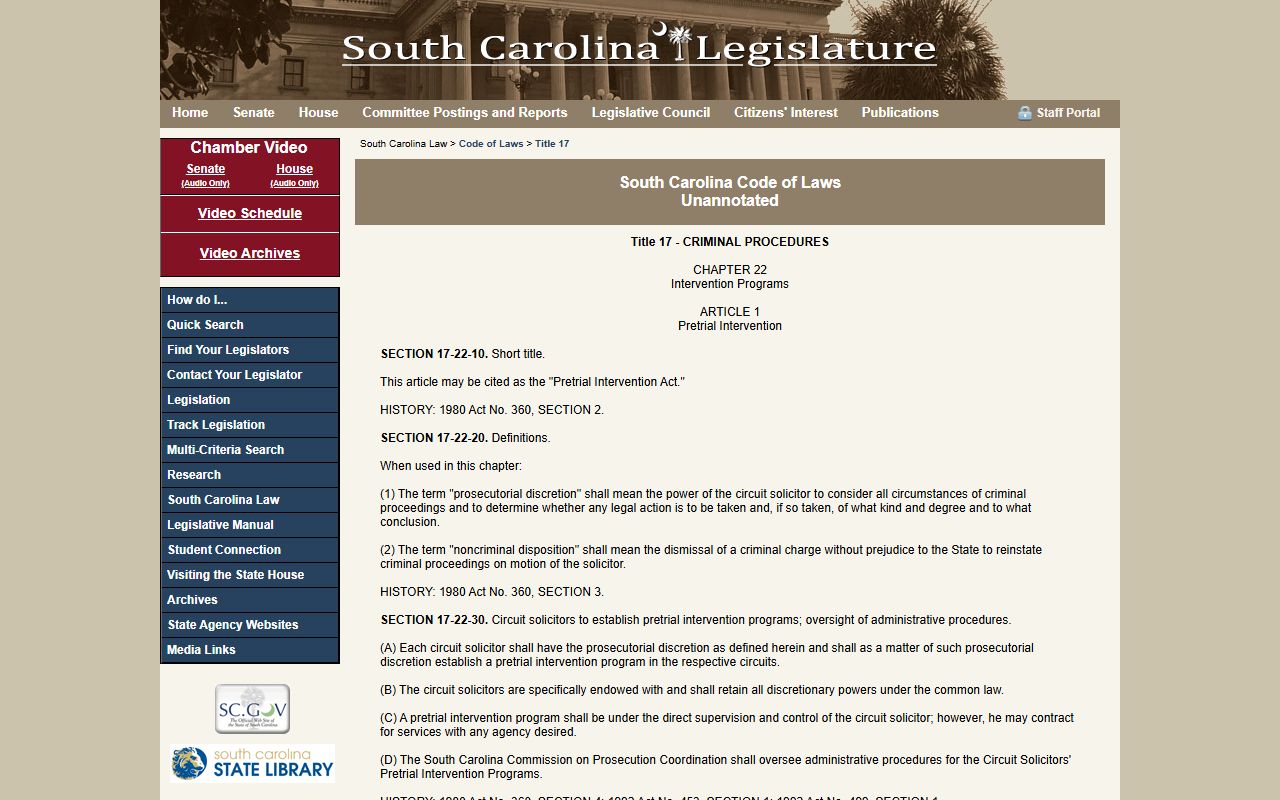
That statute source matters because Kershaw County criminal court records may be removed from public view only through the state expungement process.
Search Kershaw County Criminal Court Records
The primary search route is the Kershaw County Public Index through the South Carolina Judicial Branch case records search directory. Use it for public General Sessions case data, case numbers, defendant names, actions, disposition entries, and financial information when the tab is enabled. If a document image is missing, older, restricted, or not scanned, the Clerk of Court is the copy source for Circuit Court files.
- Open the South Carolina case records search directory and select Kershaw County.
- Search by case number when known, or by defendant name with criminal case filters and date ranges.
- Open the case-number link and review charges, actions, appearance entries, financial information, and disposition status.
- Check whether the case belongs to General Sessions, Magistrate Court, or a Municipal Court before requesting copies.
- Contact the Clerk of Court for certified Circuit Court copies and allow two days when the case is not online.
- Use the Fifth Circuit Solicitor for prosecution-side records, charging decisions, expungement, or solicitor FOIA questions.
For minor or city-level criminal matters, a county Public Index search may not be enough. Magistrate Court handles summary criminal offenses, preliminary hearings, bail, and warrants. Municipal Courts handle city ordinance and municipal criminal matters. A jail roster can show custody and hold reasons, but the criminal case file and final court outcome must be checked through the court record.
Kershaw Criminal Case Stages
Kershaw County criminal court records should be read as a sequence. An arrest or citation may start the process, but the court record develops as the case moves through appearance dates and filings. The Fifth Circuit General Sessions process states that after arrest, the bond form lists the first court date. If counsel files a Notice of Representation with the Clerk and delivers it to the Solicitor, the defendant may not have to attend the first appearance, but must attend the second.
Case flow: Charges Filed › Arraignment › Pretrial / Motions › Plea or Trial › Disposition › Sentencing
| Stage | What Happens |
|---|---|
| Charges filed | The prosecutor, officer, or grand jury route places a charge into the court process. |
| Appearance / arraignment | The defendant receives or confirms court dates, counsel status, and next steps. |
| Pretrial / motions | Attorneys file motions, request hearings, exchange information, or seek rulings. |
| Plea or trial | The charge is resolved by plea, verdict, dismissal, or other court action. |
| Disposition | The court records the outcome for each charge. |
| Sentencing | The case may show jail, prison, probation, fines, costs, restitution, or other terms. |
The South Carolina Judicial Branch source image comes from the state expungement application process overview.
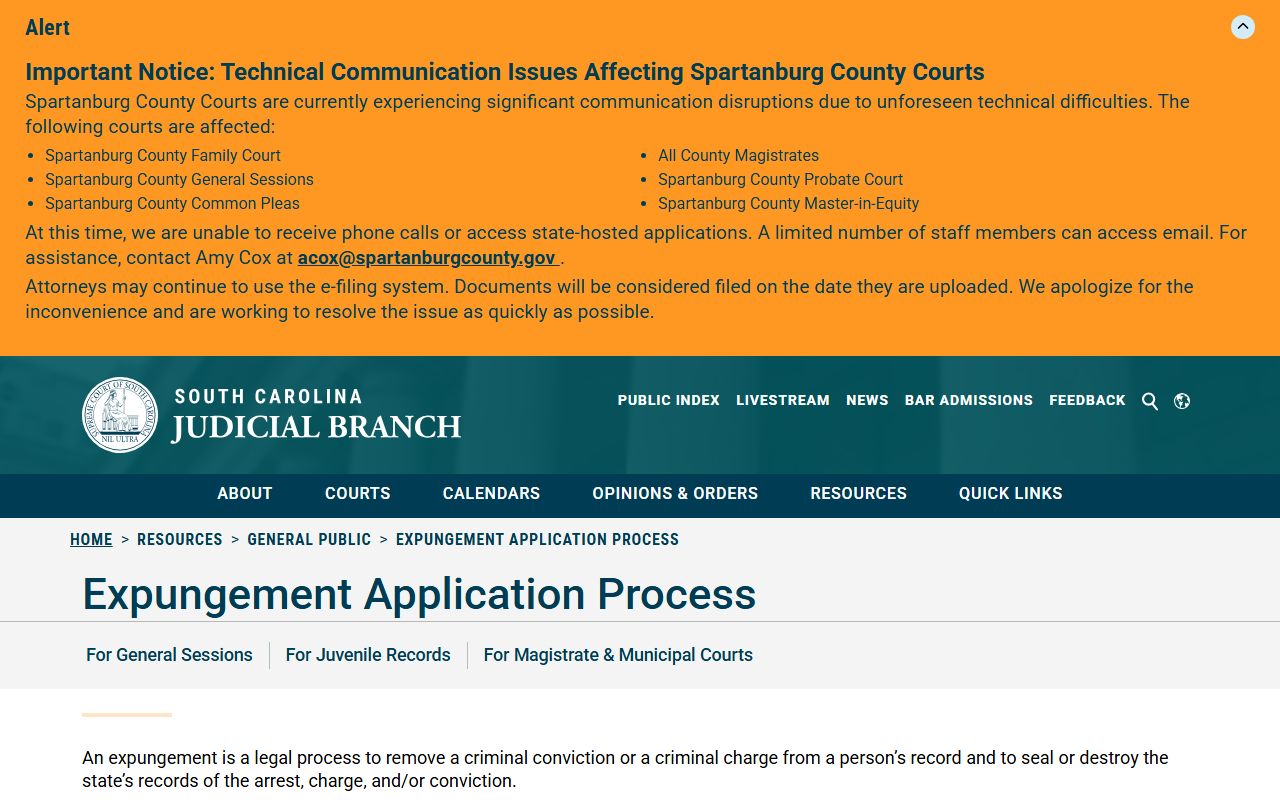
Expungement is part of the later criminal-record lifecycle, not the first search step for a pending Kershaw County criminal court case.
Kershaw Criminal Court Record Fields
A Kershaw County criminal court record can show case metadata and case activity, but it may not show every police or prosecution file. The court file is usually the best source for case number, filed charges, hearing history, plea, disposition, sentence, and court costs. Incident reports, body-camera issues, and law-enforcement records use the Sheriff's Office FOIA process or the relevant agency's records path.
| Field | What It Shows |
|---|---|
| Case number | The court identifier used for General Sessions, Magistrate, or Municipal case lookup. |
| Defendant | The person accused in the criminal case, with protected identifiers redacted. |
| Charges | Offense descriptions, charge codes, warrant or ticket references, and charge status where available. |
| Actions | Docket events such as appearances, filings, motions, hearings, orders, and judgments. |
| Plea | The defendant's formal response, such as guilty, not guilty, or another court-entered plea. |
| Disposition | The outcome of each charge, including conviction, acquittal, dismissal, or nolle prosequi. |
| Sentence | Jail, prison, probation, fines, costs, restitution, or other terms if entered. |
| Financials | Court costs, fines, payments, balances, or related financial records where enabled. |
The General Sessions source image comes from the South Carolina General Sessions expungement process.
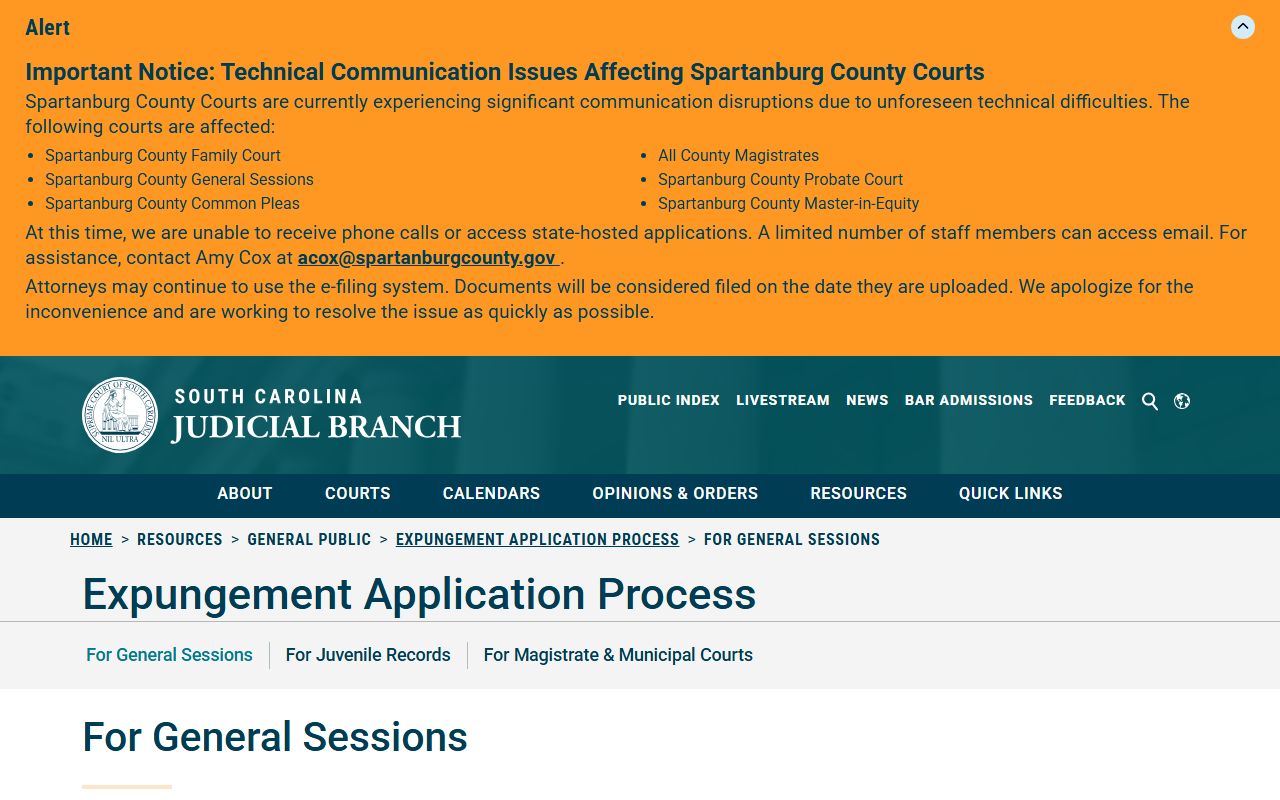
General Sessions is the key Kershaw County criminal court record path for felony-level prosecution and later expungement review.
Kershaw Charges vs Convictions
A charge is an accusation filed with the court. A conviction is a final outcome based on a guilty plea, verdict, or other conviction entry. Kershaw County criminal court records can include charges that were later dismissed, reduced, amended, nol prossed, or ended in not guilty. For that reason, the disposition field matters as much as the charge title.
| Charge | Conviction | |
|---|---|---|
| Stage | Filed accusation after arrest, citation, warrant, or grand-jury action. | Final court outcome after plea, verdict, or other resolution. |
| Record meaning | Shows what the person was accused of, not guilt by itself. | Shows that the case or charge ended in a conviction. |
| Where checked | Public Index, charge record, jail hold reason, or issuing summary court. | Disposition and sentencing entries in the court case file. |
| Can change? | Yes, charges may be amended, reduced, dismissed, or nol prossed. | Changes usually require appeal, post-conviction action, pardon, or expungement if eligible. |
Read Kershaw Dispositions
Disposition means the result of a case or charge. Kershaw County criminal court records may show guilty, not guilty, dismissed, dismissed with prejudice, dismissed without prejudice, nolle prosequi, or other court-specific outcomes. Nolle prosequi means the prosecutor declined to continue that prosecution. A dismissal without prejudice may allow refiling if law permits, while a dismissal with prejudice generally bars the same charge from being brought again.
Sentencing is a separate layer. A conviction may include jail or prison time, probation, court costs, fines, restitution, or other conditions. If the person is in current county custody, jail information may be visible through the Detention Center roster, but custody status is not the same as the final Kershaw County criminal court record. The court file controls the official disposition.
The Magistrate and Municipal Court source image comes from the South Carolina summary court expungement process.
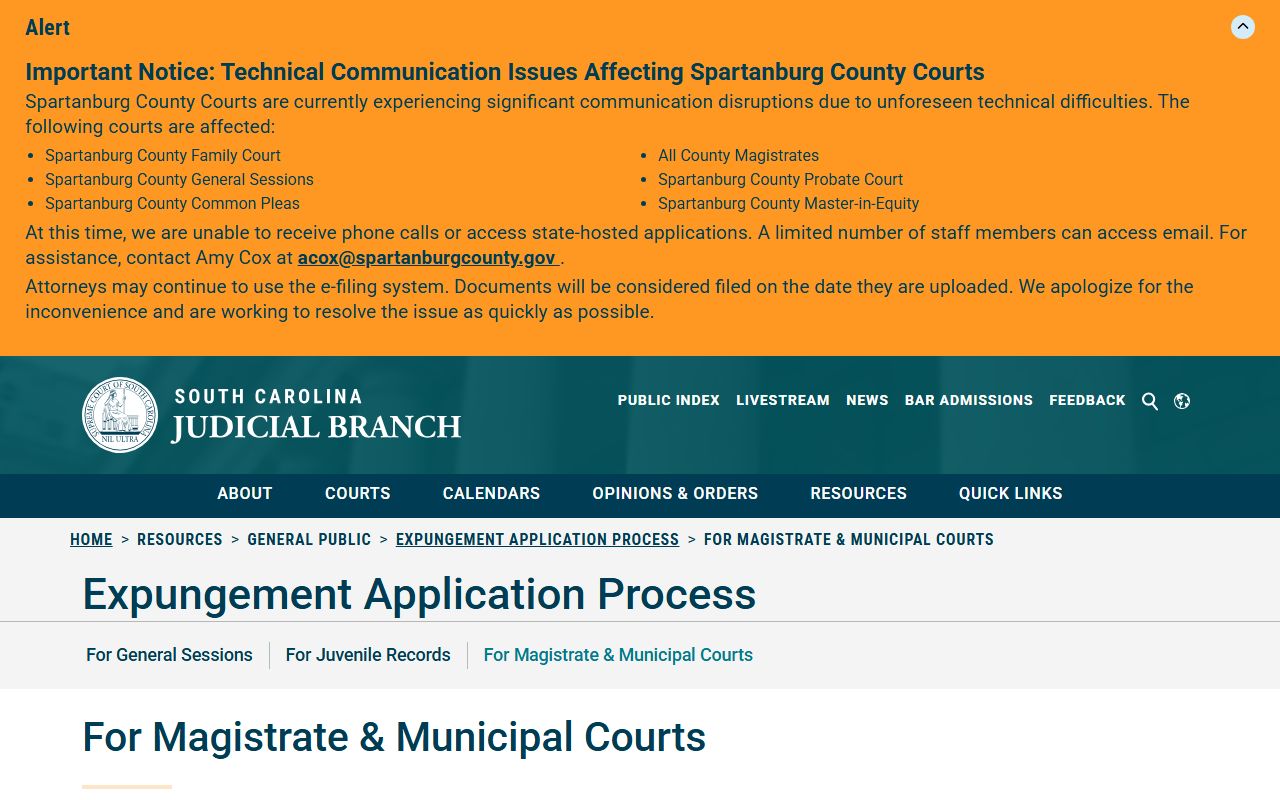
Summary court criminal records in Kershaw County can follow a different court path from General Sessions, but expungement still routes through the solicitor process.
Kershaw Sealed vs Expunged Records
Sealed and expunged records are both restricted from ordinary public access, but they are not the same. Rule 41.1 provides a sealing process when a court finds a legal basis for limiting public access. Expungement is a statutory process that removes, seals, or destroys eligible arrest, charge, or conviction records. Kershaw County expungement matters use the Fifth Judicial Circuit Solicitor because the county is in that circuit.
| Sealed | Expunged | |
|---|---|---|
| Visibility | Hidden from public access under a court order. | Removed, sealed, or destroyed under statutory expungement authority. |
| Process | Motion and court findings under the sealing rule. | Application through the solicitor in the circuit where the charge originated. |
| Kershaw route | The court that controls the case handles sealing questions. | Fifth Judicial Circuit Solicitor handles eligible Kershaw expungement applications. |
| Typical limits | Depends on the order and the reason for sealing. | Eligibility depends on charge outcome, offense type, and state law. |
The local expungement source image comes from the Fifth Circuit Solicitor expungement page.
The Fifth Circuit page is the local Kershaw County criminal court records source for expungement authority, fees, and eligibility direction.
Kershaw Criminal Records Access
Public criminal case access is limited by court rules, state confidentiality statutes, and redaction duties. South Carolina FOIA supports public-record access, but court records also follow court rules. Juvenile court records are confidential under S.C. Code Sections 63-19-2010 and 63-19-2020. Protected identifiers are controlled by S.C. Code Section 30-2-330 and Rule 41.2. Expungement procedures are addressed in S.C. Code Sections 17-22-910 and 17-22-940.
Important: Public criminal case lookup is not a consumer report and should be verified with the court before legal use.
Prosecution records and solicitor-side FOIA requests are separate from Clerk case copies. The Fifth Circuit Solicitor FOIA form asks for requester identity, warrant number associated with the defendant or victim, requested information, requester type, and fee acknowledgments. Search, retrieval, and redaction are listed at $20 per hour, with copy and media fees for produced records.
The final assigned criminal records image comes from the Fifth Circuit Solicitor FOIA request form.
That form is relevant when Kershaw County criminal court record research needs solicitor records rather than the court docket kept by the Clerk.
Restricted Kershaw Criminal Records
Restricted Kershaw County criminal court records include juvenile records, sealed records, expunged records, confidential reference lists, protected personal identifiers, and non-public documents in ongoing or sensitive proceedings. Search warrants may be sealed or unavailable before execution. Active law-enforcement records can also be withheld when disclosure would interfere with an investigation or fall within a FOIA exemption.
When a public record is missing from the portal, the absence does not prove that no case exists. The record may be too new, too old, filed in a summary court, assigned to a municipal court, restricted by law, or kept by another office. The best next step is to identify the court named on the ticket, warrant, bond form, or notice, then use the specific Clerk, Magistrate, Municipal Court, Solicitor, or law-enforcement channel that owns that record.